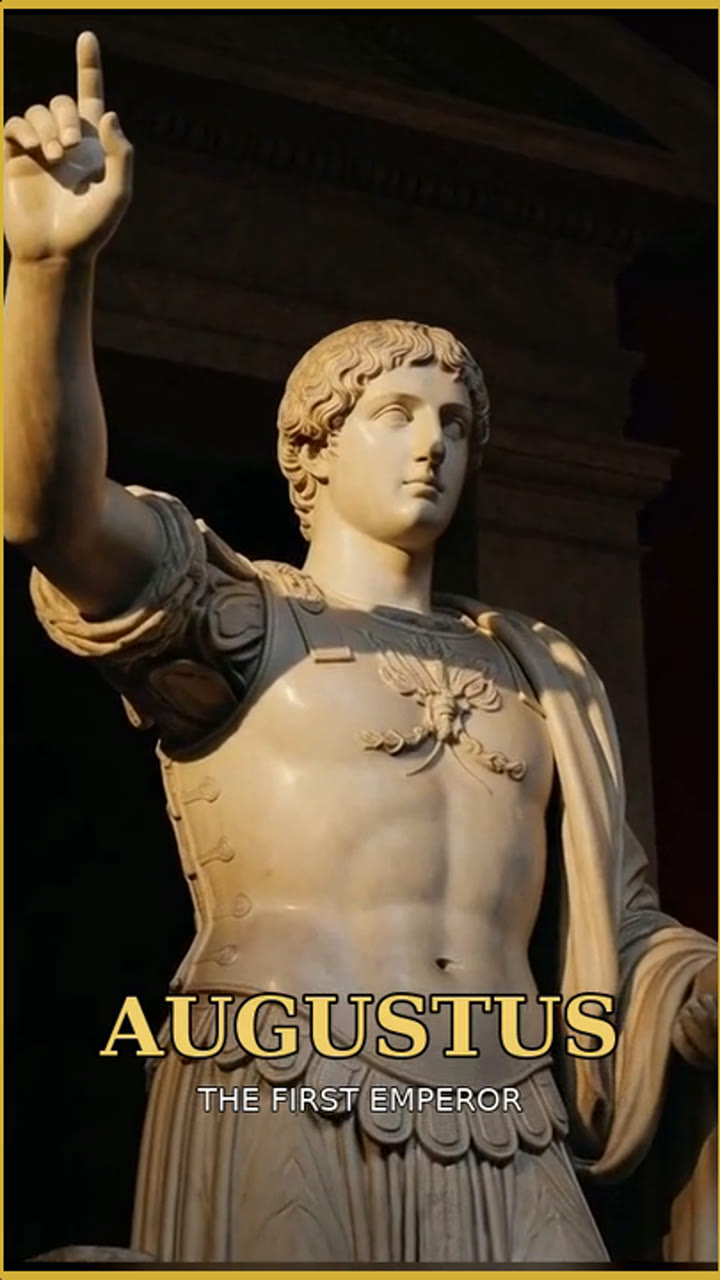
The triumvirate: three men divide the world
The young heir — Octavian, as Rome called him — did not wait to grow up. He made a pact with Mark Antony and Lepidus: the triumvirate. The three divided the Roman world between them, and signed death lists for their enemies. Thousands were proscribed, hunted and killed, their property seized to pay the armies.
Philippi: the avengers
First came revenge. At Philippi in Macedonia, the triumvirs destroyed the armies of Caesar's assassins, Brutus and Cassius. The republic, in truth, died on that field too — what remained was a question of which triumvir would rule what was left.
Actium, and the fall of Egypt
The partners became rivals. At Actium in 31 BC, Octavian's fleet broke the forces of Antony and Cleopatra — and a century of civil war was nearly over. Alexandria fell; Antony and Cleopatra died by their own hands; and Egypt, the breadbasket of the Mediterranean, became the emperor's personal estate.
The settlement of 27 BC
Then came the masterstroke. In 27 BC Augustus stood before the Senate and handed all his powers back — theatre, and genius. The senators begged him to keep them, and gave him a new name instead: Augustus, the revered one. He ruled for forty more years, always careful to call it a republic.
Brick into marble
He boasted that he found Rome built of brick and left it built of marble — and the boast was very nearly true. His own Forum of Augustus told the new story of Rome in stone: a temple to Mars the Avenger, and a marble line of Roman heroes that now ended with him. On the Ara Pacis, the Altar of Peace, he carved his real achievement: his family processing in marble, teaching an empire to be grateful for quiet.
For ordinary people the change was simple: forty years without civil war. Roads safe, seas swept of pirates, bread on time. They loved the peace — and the man whose face was on it.
The wound that never healed
One disaster shadowed the reign. In AD 9, in the Teutoburg Forest in Germany, three entire legions were ambushed and annihilated. The old emperor, it was said, would wander his palace at night crying out: "Give me back my legions!" Rome's frontier stopped at the Rhine — and stayed there.
Death at Nola, and the verdict of history
Travelling in the summer of AD 14, Augustus fell ill at Nola and died there, aged seventy-five, his wife Livia at his side. Tradition hands the actor-emperor an actor's exit line: "Have I played the part well? Then applaud, as I leave the stage."
Historians still argue over him: the cold revolutionary who proscribed and murdered his way to the top — or the greatest statesman Rome ever produced, who built the machine that ran the ancient world for centuries? What is certain is the legacy: frontiers, a treasury, a system of rule — and a name. Every emperor after him took his very name as a title, Augustus, and wore it for fourteen centuries.
Watch the one-minute film
This story is a History Flashback short — one ruler, one minute, fifteen scenes. Watch Augustus's film on the SCN channel, then read the reign that followed.
▶ Watch Augustus on YouTubeSources: Suetonius, The Twelve Caesars; the Res Gestae Divi Augusti (Augustus' own account of his reign); Cassius Dio, Roman History. A History Flashback story from SCNviral — See Beyond the Headline.
Questions people ask about Augustus
Who was the first Roman emperor?
Augustus. Born Octavian, he was Julius Caesar's adopted heir; in 27 BC the Senate gave him the name Augustus — "the revered one" — and he ruled Rome for more than forty years, turning a republic into an empire while still calling it a republic.
How did Augustus become emperor?
Step by step: he avenged Julius Caesar at Philippi as one of the triumvirate, defeated Mark Antony and Cleopatra at Actium in 31 BC, and annexed Egypt. Then, in 27 BC, he theatrically handed his powers back to the Senate — which begged him to keep them. The Emperor Augustus never took the title of king; he simply never gave the power back.
How long did Augustus rule?
For over forty years, from 27 BC until his death at Nola in AD 14, aged seventy-five — long enough for a whole generation of Romans to grow up knowing no other ruler.
What was Augustus Caesar known for?
Augustus Caesar is known for ending a century of Roman civil war and founding the Roman Empire: he defeated Mark Antony and Cleopatra, annexed Egypt, and then ruled for over forty years of peace — the Pax Romana — while still calling Rome a republic. The ruler the world remembers as Caesar Augustus turned a bleeding republic into an empire built to last.