Walls over wars
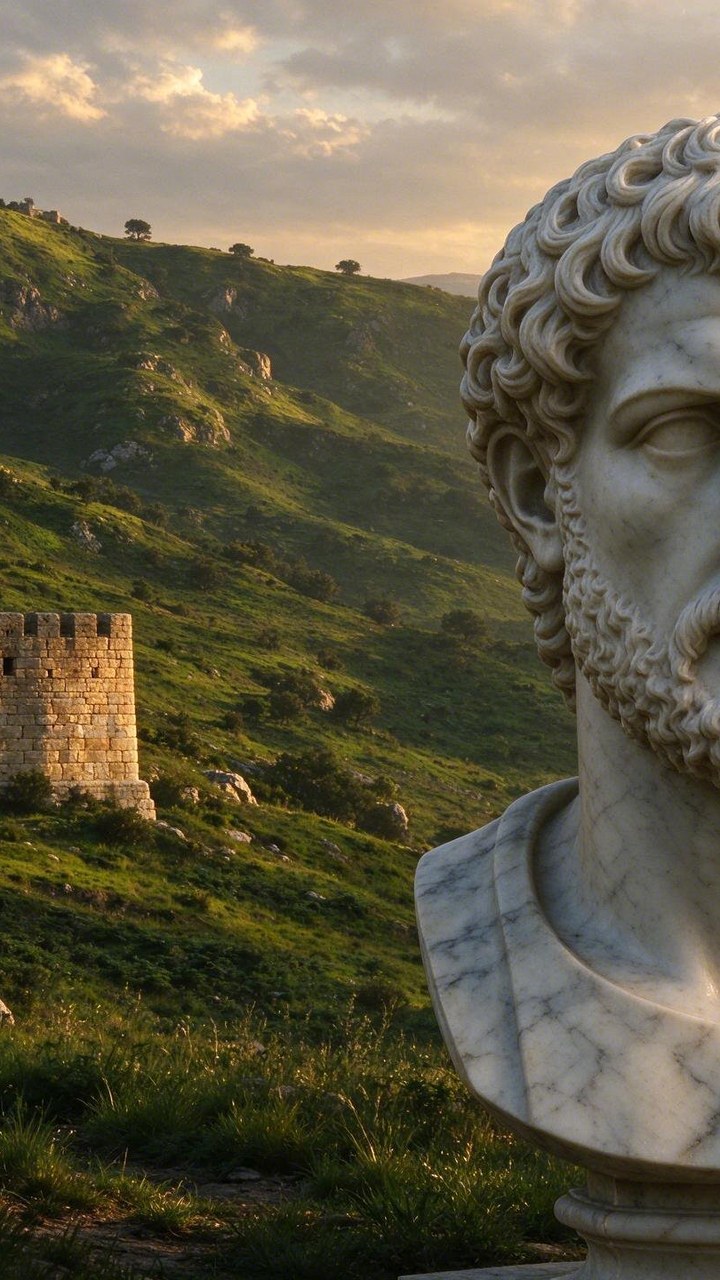
War found him anyway: in Judaea, the Bar Kokhba revolt took three brutal years to crush. Everywhere else, Hadrian chose walls over wars — a timber palisade through the forests of Germany, forts along the Danube, and frontiers surveyed, marked and held. He was the first emperor to treat the empire's borders as a design, not a starting line.
Hadrian's Wall
Across northern Britain he built the famous one: seventy-three miles of stone curtain wall running coast to coast, with a fortified milecastle every Roman mile and turrets in between. Nineteen centuries later, walkers still follow its line across the hills — the most complete ancient Roman frontier monument on Earth.
The Pantheon and the villa the size of a city
In Rome he rebuilt the Pantheon — an architectural triumph — giving it the great coffered dome and open oculus that still astonish engineers — its dome remains the largest of its kind in the world. And at Tivoli he built the Villa Adriana: palaces, pools, theatres and copies of the wonders of Egypt and Greece — a museum of everything he had seen on his travels, the size of a city.
The travelling emperor
No emperor travelled more. Hadrian spent years on the road — inspecting armies, founding cities, hearing petitions from Britain to Syria. The provinces loved him for it, and many cities took his name. But the Senate never forgave the four senators executed when he took power, and they hated him to the end.
The farewell poem, and the verdict of history
Dying slowly and in pain at Baiae, Hadrian did one last imperial thing: he arranged the succession — twice — on paper, choosing the line that would give Rome Antoninus Pius and Marcus Aurelius. He wrote his own farewell, a tiny poem to his soul — "little soul, wandering and gentle" — and died in 138 AD, of illness, not the sword. They buried him in the largest tomb the city had seen, the great round mausoleum on the Tiber that stands today as Castel Sant'Angelo.
Historians rank him among the Five Good Emperors: not Rome's conqueror — its second founder. The borders he drew outlived the empire itself. It is a legacy written in stone.
Watch the one-minute film
This story is a History Flashback short — one ruler, one minute, fifteen scenes. Watch Hadrian's film, then read how his predecessor took the empire to its greatest reach.
▶ Watch Hadrian on YouTubeSources: Cassius Dio, Roman History; the Historia Augusta, Life of Hadrian. A History Flashback story from SCNviral — See Beyond the Headline.
Questions people ask about Hadrian
Why did Hadrian build Hadrian's Wall?
To mark and defend the northern edge of the empire. The Emperor Hadrian had decided it was big enough; the wall turned an open frontier into a controlled, guarded line — a border designed, not just defended.
How long is Hadrian's Wall?
Seventy-three miles — about 117 kilometres — across northern Britain, from the Irish Sea to the North Sea, with a fortified milecastle every Roman mile and turrets in between. Walkers still follow its line across the hills today.
What did Hadrian build in Rome?
Two landmarks that still stand: the Pantheon, rebuilt with its great coffered dome and open oculus, and his own mausoleum on the Tiber — the vast round tomb that survives today as Castel Sant'Angelo. At Tivoli he also built the Villa Adriana, a palace complex the size of a city.
Was Hadrian a good emperor?
Historians rank the Emperor Hadrian among the Five Good Emperors: not Rome's conqueror but its second founder, who traded expansion for strong borders and spent years travelling the provinces in person. The Senate, which never forgave the executions at his accession, hated him to the end.