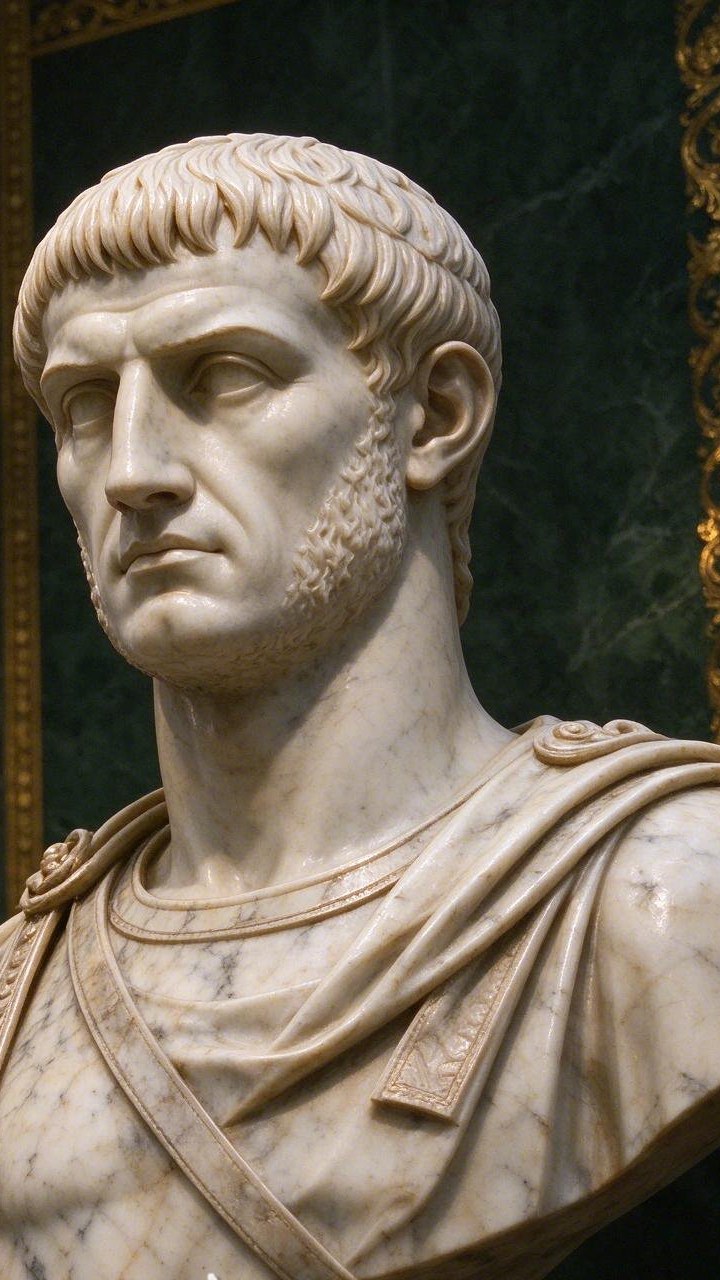
Optimus Princeps — the Best Ruler
He was born in Italica, in Roman Spain — the first emperor from the provinces, and a soldier before he was a ruler. When Trajan entered Rome on foot, like a citizen, refusing ceremony, the Senate named him Optimus Princeps: the Best Ruler. It was not flattery. What followed was the most successful reign in Roman history.
Dacia: the bridge and the gold
His first great war was Dacia, beyond the Danube. To reach it, his engineers threw the longest bridge of the ancient world across the great river — stone piers, a timber roadway — and the legions marched over it. Two military campaigns later Dacia fell, and its gold mines brought Rome a generation of wealth.
Arabia, Parthia, and the Gulf
In the east he annexed Arabia almost without a battle — Petra's carved rose-red city became Roman. Then came Parthia: Babylon and Ctesiphon taken, until Trajan stood on the shore of the Persian Gulf, watching Roman warships — and sighed that he was too old to follow Alexander to India.
The builder
Dacia's gold — the wealth of a conquered kingdom — built Rome's grandest forum, and beside it Trajan's Column — a stone scroll that tells his wars in a spiral of carved battles, still standing in Rome today. Beyond the capital came the greatest infrastructure projects of the ancient world: military roads, harbours, aqueducts, from Britain to Mesopotamia.
The people's emperor
The people loved him: welfare programs for Rome's children — the alimenta — taxes eased, a hundred days of games. For centuries afterwards, every new emperor was greeted in the Senate with one ceremonial wish: "Luckier than Augustus — better than Trajan." Dante, writing thirteen centuries later, placed this pagan ruler in Paradise. Historians agree on the essential fact: the empire Trajan left behind was the largest Rome would ever be.
Death in Cilicia, 117 AD
The east was already slipping from his grip when sickness struck him on the journey home. He died in Cilicia in 117 — of illness, not the sword. His ashes came home to Rome and were laid to rest beneath his Column, the only emperor buried within the city's sacred boundary. His conquests became the empire's outline for centuries — the greatest reach, never repeated. His successor Hadrian would have to defend it.
Watch the one-minute film
This story is a History Flashback short — one ruler, one minute, fifteen scenes. Watch Trajan's film, then read how Hadrian decided where the empire ended.
▶ Watch Trajan on YouTubeSources: Cassius Dio, Roman History; Pliny the Younger, Panegyricus; Eutropius, Breviarium. A History Flashback story from SCNviral — See Beyond the Headline.
Questions people ask about Trajan
Why is Trajan called the best emperor?
The Senate named him Optimus Princeps — the Best Ruler — and for centuries afterwards every new ruler was greeted with the wish: "Luckier than Augustus, better than Trajan." Under Trajan the empire reached its greatest extent, the treasury was full, and Rome enjoyed a hundred days of games.
How big was the Roman Empire under Trajan?
The largest it would ever be — the high-water mark of Roman conquests. Trajan conquered Dacia beyond the Danube, annexed Arabia, and took Babylon and Ctesiphon in the east, reaching the Persian Gulf. The empire his successor Hadrian inherited was never larger.
What is Trajan's Column?
A stone column carved with a spiral of scenes from Trajan's Dacian wars — a war report in marble, still standing today. Trajan's ashes were laid to rest beneath it, the only ruler buried inside the city's sacred boundary.
Where did Trajan die?
In Cilicia, in 117 AD, struck down by illness on the journey home from his eastern campaigns. He died of sickness, not by the sword.