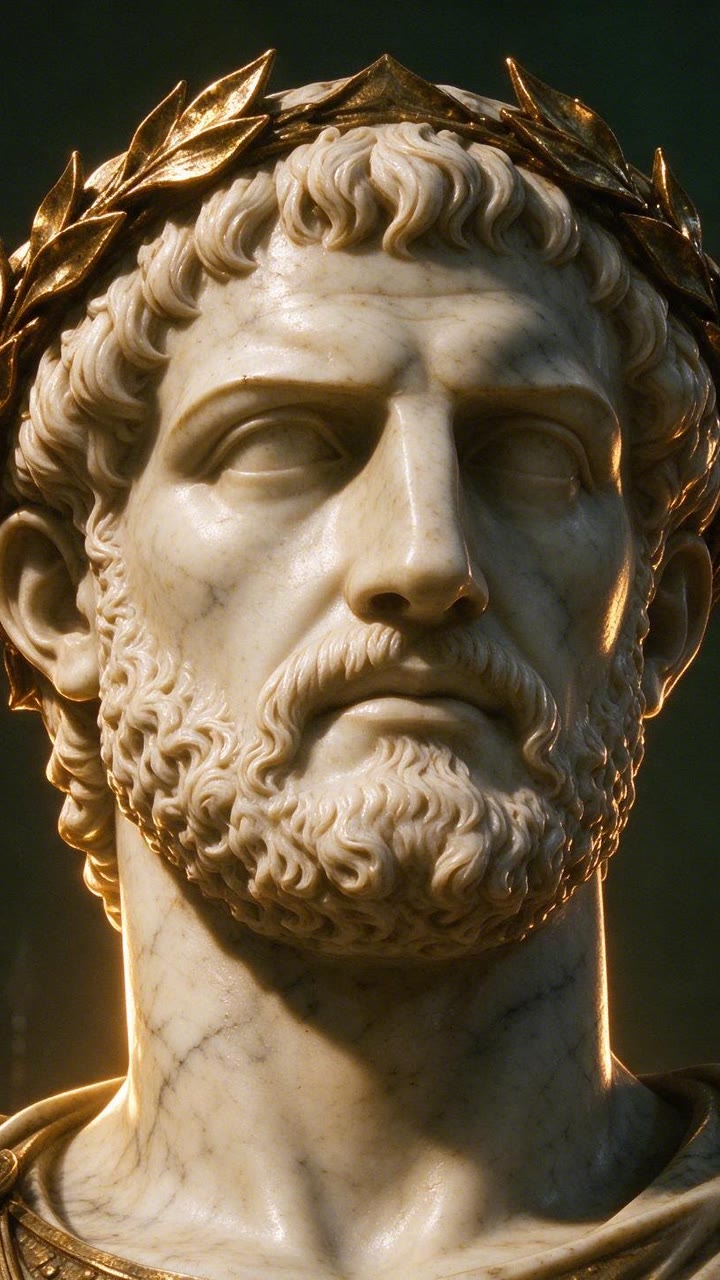
The ambitious young Roman
At thirty-two, standing before a statue of Alexander the Great in Spain, Julius Caesar wept. Alexander had conquered the known world by that age; Caesar, for all his talent, had done nothing. It was the last time anyone could say that of him. He climbed every office ancient Rome had to offer — and then took the one prize that mattered: command of her armies in Gaul.
Gaul, and the double walls of Alesia
For year after year Caesar campaigned across Gaul, and his masterpiece was the siege of Alesia in 52 BC. Trapped between the Gallic army inside the hilltop town and a vast relief army outside, he built not one wall but two — one ring to starve the town, one to hold off the rescuers — and beat both armies. Gaul was his, and so was the loyalty of the legions who had won it.
The Rubicon
Ordered to return to Rome as a private citizen — powerless, and at the mercy of his enemies — Julius Caesar made the decision that still echoes in our language. In January 49 BC he led his army across the Rubicon, the river that marked Italy's border, with the words tradition gives him: "the die is cast." It was treason, and he knew it. He marched on Rome itself.
The civil war was swift. He crushed Pompey at Pharsalus in Greece, followed him to Egypt — and there met Cleopatra. Five years, four wars, total victory. Rome, exhausted, made him dictator for life.
The builder of time itself
Julius Caesar stamped his name on the city: a new Forum of Caesar, a new Senate house. And he rebuilt time itself — the Julian calendar, reformed with Egyptian astronomy, is still the skeleton of the calendar on your wall today.
Loved by the people, feared by the Senate
The Roman people adored him: grain distributions, games, land for veterans, debts forgiven. But in the Senate, men watched a king growing — the purple robe, the gold chair, the honours piling up — and Rome had sworn an oath centuries before: never again a king.
The Ides of March
A soothsayer had warned him: "Beware the Ides of March." Caesar laughed, and walked on. On 15 March 44 BC, in the Senate house, the conspirators surrounded him with daggers drawn. He took twenty-three wounds — the last, tradition says, from Brutus, his friend — and fell dead at the base of Pompey's statue.
The verdict of history
Historians still divide over Caesar: was he the republic's executioner — or the only surgeon who could have saved it? The assassins wanted the republic back. What they got was thirteen more years of civil war, and then Caesar's heir: Augustus, the first emperor. Caesar lost his life on the Ides of March. He won the future anyway.
Watch the one-minute film
This story is a History Flashback short — one ruler, one minute, fifteen scenes. Watch Caesar's film, then explore the emperors who followed him.
▶ Watch Caesar on YouTubeSources: Caesar, Commentaries on the Gallic War; Suetonius, The Twelve Caesars; Plutarch, Life of Caesar. A History Flashback story from SCNviral — See Beyond the Headline.
Questions people ask about Julius Caesar
Who killed Julius Caesar?
A group of senators — around sixty conspirators led by Brutus and Cassius — stabbed him on the Ides of March, 15 March 44 BC, in the Senate house. He took twenty-three wounds and fell dead at the base of Pompey's statue.
Why do we say "crossing the Rubicon"?
Because Caesar's crossing in January 49 BC was a point of no return. Leading an army across the river that marked Italy's border was treason, and civil war became unavoidable the moment he crossed. The phrase still means passing the point where there is no going back.
Was Julius Caesar really abducted by pirates?
Yes. As a young man of about twenty-five, sailing in the eastern Mediterranean, he was captured by Cilician pirates and held for ransom. Once freed, he raised ships, hunted the pirates down and had them executed — exactly as he had jokingly promised them while he was their prisoner.