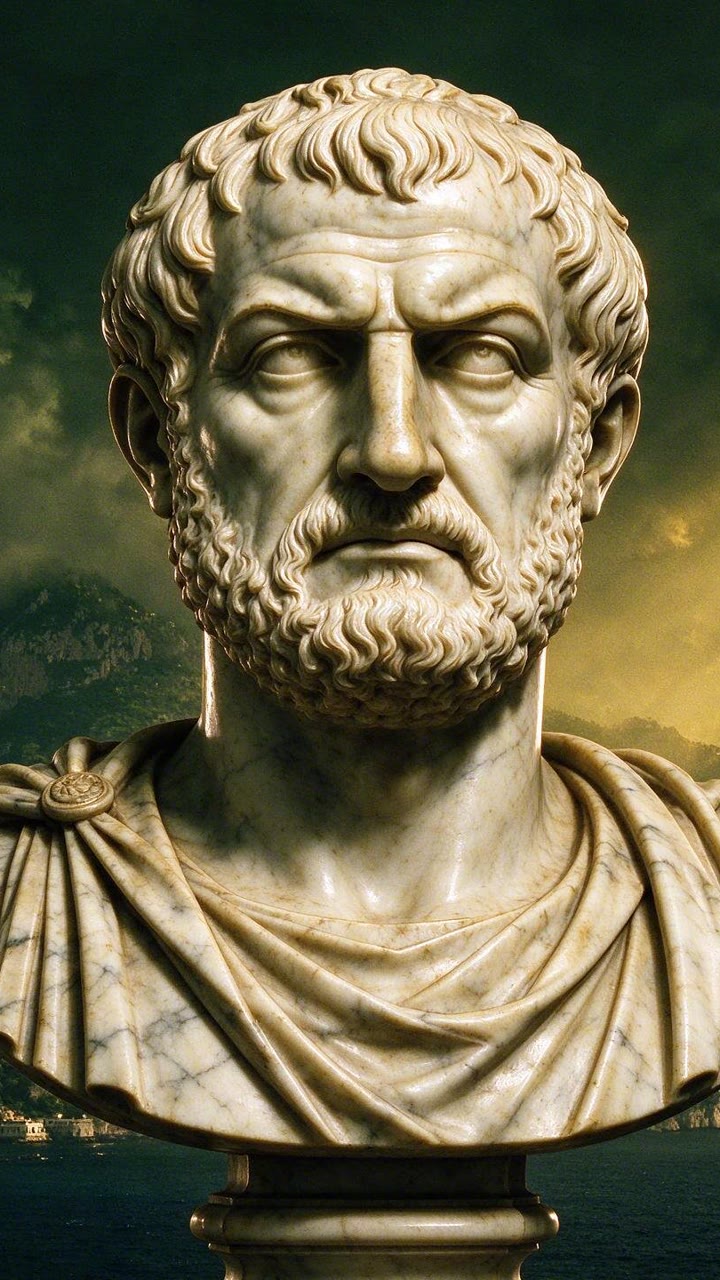
Rome's finest general, pushed aside
Tiberius, stepson of Augustus, won Rome's Alpine and German frontiers campaign by campaign — a military record no Roman of his generation could match. Yet when the succession was arranged, younger heirs were preferred — and in disgust he withdrew to the island of Rhodes, exiling himself for seven years while Rome all but forgot him. One by one, every preferred heir died. Adopted at last by the old emperor, Tiberius was the second emperor from AD 14 — reluctantly, grimly, and with the whole empire watching for a mistake.
The lost eagles, recovered
His nephew Germanicus marched back into Germany, stood among the bones of the legions destroyed in the Teutoburg Forest — and brought home two of the three lost eagle standards. In Africa, the rebel Tacfarinas, a deserter Rome itself had trained, fought a seven-year guerrilla war in the desert before Tiberius' generals finally ran him down.
The full treasury, and the island
Tiberius spent on almost nothing — few games, no vanity palaces — and the money piled up: when he died, the treasury held a fortune in reserve, billions of sesterces. Then, in AD 26, he withdrew to Capri, to a villa on the cliffs — and never saw Rome again. For eleven years, an empire took its orders from an island.
Two reigns in one
Out in the provinces his rule was quietly excellent: honest governors kept in post for years, taxes steady, no reckless new wars. Most of the empire had never been governed better. But in Rome the reign curdled into fear. The treason trials multiplied, informers grew rich on accusations — and a careless word about the emperor could end a great family.
The terror had a manager: Sejanus, captain of the imperial guard, who ruled the capital in the absent emperor's name. When Sejanus reached for the throne himself, a single letter from Capri was read aloud in the Senate — and he was dead before dark.
Death at Misenum, and the verdict of history
In AD 37, ill and restless, the Emperor Tiberius left Capri and was carried north — and got only as far as Misenum, on the Bay of Naples. He died there in March, aged seventy-seven. Rome repeated the rumour that he had stirred, called out for food — and been smothered under his own bedclothes. It was never proven.
Tacitus, the great Roman historian, painted him a hypocrite rotting slowly into cruelty. Modern historians of ancient Rome read the record instead: an able, frugal ruler — corroded by suspicion, grief, and a job he never wanted. His legacy was the rarest of inheritances: full coffers, secure frontiers, and an empire that worked.
Watch the one-minute film
This story is a History Flashback short — one ruler, one minute, fifteen scenes. Watch Tiberius's film on the SCN channel, then read about the soldier-emperor who took Rome to its greatest reach.
▶ Watch Tiberius on YouTubeSources: Tacitus, Annals; Suetonius, The Twelve Caesars. A History Flashback story from SCNviral — See Beyond the Headline.
Questions people ask about Tiberius
Why did Tiberius leave Rome?
In AD 26 he withdrew to a villa on the cliffs of Capri — and never saw Rome again. For eleven years the empire took its orders from the island, while his guard captain Sejanus ruled the capital in his name. His reasons are still debated: weariness with the Senate, suspicion, and grief all played their part.
Who succeeded Tiberius?
Caligula, the young son of his nephew Germanicus, became emperor in AD 37. Tiberius had outlived every heir of his own generation, and the throne passed to the last surviving son of Rome's most beloved general.
Was Tiberius a good emperor?
It depends where you stood. In the provinces his rule was quietly excellent — honest governors, steady taxes, no reckless wars, and a treasury left full. In the capital he is remembered for the treason trials and the terror of Sejanus. Modern historians judge him an able, frugal ruler corroded by suspicion.
How did Tiberius die?
He died at Misenum, on the Bay of Naples, in March AD 37, aged seventy-seven, after an illness. A rumour went round that he had revived and been smothered under his own bedclothes — it was never proven.