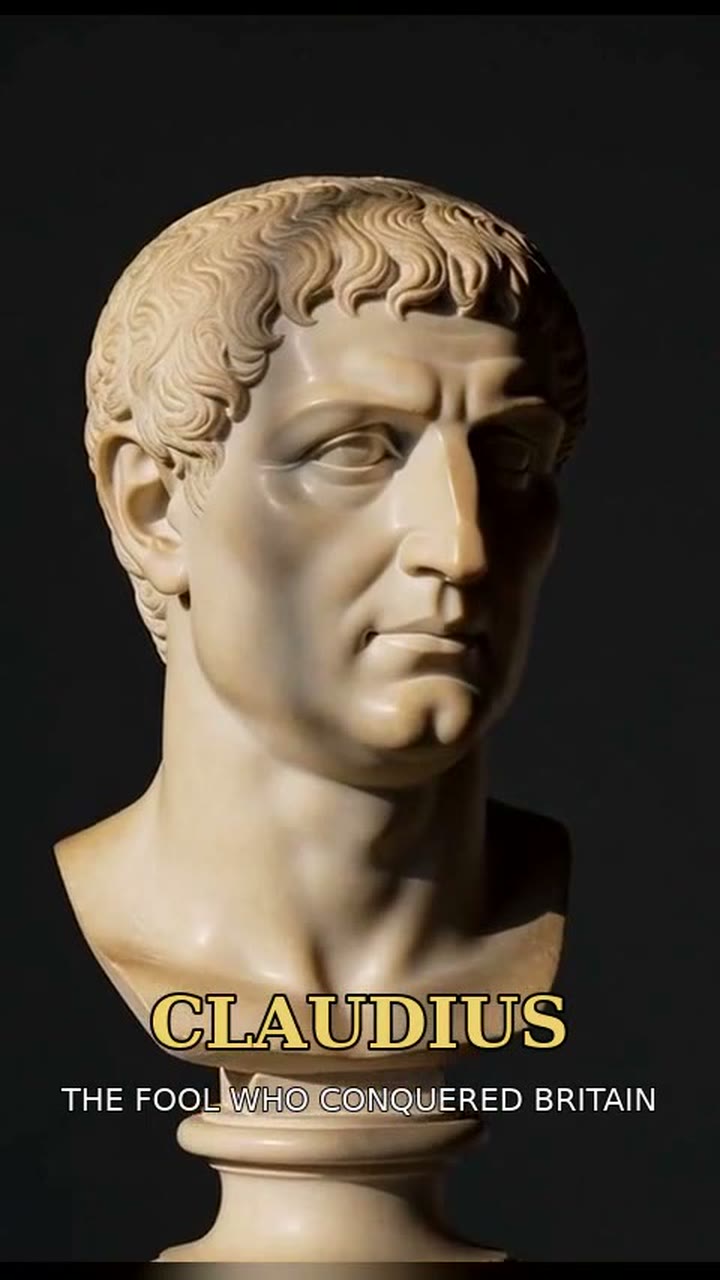
The family's embarrassment
Claudius was born into the first family of ancient Rome — the nephew of Augustus, the uncle of Caligula — and his family was ashamed of him. He limped, he stammered, and when he was nervous his head shook. His own mother, Antonia, called him a monster of a man, and the imperial family kept him out of public life, hidden away with his books. So he did what outcasts do: he read. He became the family's scholar, writing histories of Rome and the Etruscans while his relatives ruled the empire.
Found behind the curtain
On 24 January AD 41, the emperor Caligula was murdered by his own guards, and the palace fell into chaos. A soldier searching the palace pulled back a heavy curtain — and found a terrified Claudius hiding behind it, begging for his life. The Praetorian Guard carried him to their camp and proclaimed him emperor. The Senate, which had been dreaming of restoring the republic, had no army of its own. It had to accept him. The fool was suddenly the Roman emperor — the most powerful man on earth.
Britain, AD 43
Two years later, Claudius did what Julius Caesar had never finished: he invaded Britain. Four legions crossed the Channel, and Claudius himself followed with war elephants, arriving in person to take the submission of the British kings at Colchester. It was the first conquest of Britain, and Rome celebrated a triumph it never expected from him. Mauretania, Thrace and Lycia joined the empire on his watch too — province after province, while the Senate watched in disbelief.
The builder
Claudius built like a man who had spent his life studying how things worked. At Ostia he built Portus, a great artificial harbour in the sea itself, with twin curved breakwaters so Rome's grain ships could land safely in any storm. He finished the two aqueducts Caligula had begun — the Aqua Claudia and the Anio Novus, some sixty miles of arches — and Rome drank better water than it had in a generation. He drained the Fucine Lake through a three-mile tunnel, a work that took eleven years and thirty thousand men.
The scholar on the throne
He governed like the scholar he was: hearing court cases himself, reforming the finances, answering petitions from across the empire in his own hand. Bread stayed cheap, the courts stayed open, and ordinary Romans learned that the stammering fool kept the empire running remarkably well. But the Senate seethed. Real power in his court sat with his freedmen secretaries — ex-slaves, richer than nobles — and with his wives.
Wives, whispers and a dish of mushrooms
His wife Messalina's scandals ended in a bigamous marriage ceremony with her lover, Silius. She was executed in the gardens that same night — Claudius was told at dinner, and asked for more wine. His last wife, Agrippina, had a son of her own: Nero. She persuaded Claudius to adopt him, over his own son Britannicus, and the court began to count the days. On 13 October AD 54, Claudius ate a dish of mushrooms and died in agony by morning. Rome believed what it wanted: that Agrippina's poisoner had done her work.
The verdict of history
The writer Seneca mocked his death in a satire — heaven rejects Claudius, and he becomes a pumpkin. For centuries, the joke stuck. But modern historians judge the Roman emperor more kindly: a mocked outsider who administered an empire superbly. He left Britain Roman, the harbour built, the treasury ordered and the frontiers pushed forward on three continents. The fool had out-worked them all.
Watch the one-minute film
This story is a History Flashback short — one ruler, one minute, fifteen scenes. Watch Claudius's film, then explore the emperors who followed him.
▶ Watch Claudius on YouTubeSources: Suetonius, The Twelve Caesars; Tacitus, Annals; Seneca, Apocolocyntosis. A History Flashback story from SCNviral — See Beyond the Headline.
Questions people ask about Claudius
How did Claudius become emperor?
By accident. After Caligula was murdered on 24 January AD 41, a Praetorian guardsman found Claudius hiding behind a curtain in the palace. The Guard carried him to their camp and proclaimed him Roman emperor, and the Senate — with no army of its own — had to accept him.
Did Claudius really conquer Britain?
Yes. In AD 43 he sent four legions across the Channel and followed in person with war elephants, taking the submission of the British kings at Colchester. Julius Caesar had raided Britain twice but never conquered it; Claudius finished the job and celebrated a triumph in Rome.
How did Claudius die?
On 13 October AD 54, after eating a dish of mushrooms at a palace banquet, he died in agony by the next morning. Ancient writers blamed his wife Agrippina, who wanted her son Nero on the throne — modern historians still argue over whether it was poison or natural causes.