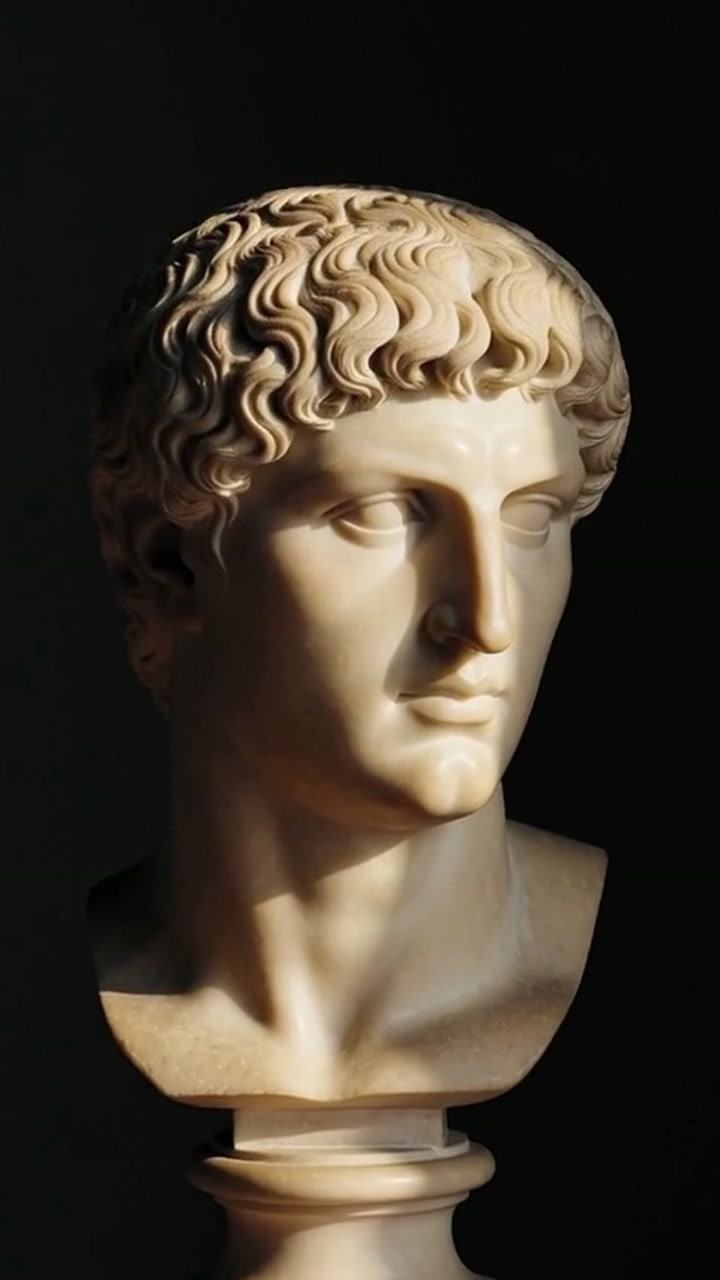
The boy behind the throne
Nero was the stepson and adopted heir of the emperor Claudius — and when Claudius died in AD 54, the seventeen-year-old boy became emperor of Rome. Everyone at court knew who had cleared his path: his mother, Agrippina, a formidable woman who had married Claudius, persuaded him to adopt her son over his own boy Britannicus, and removed everyone who stood in the way. In the first years Nero sat stiffly on the throne while Agrippina stood directly behind it, a hand on its back. The philosopher Seneca was his tutor and guide, and the first five years of the reign were praised across Rome as a golden dawn.
The performer
But Nero's true passion was not governing — it was the stage. He longed to be applauded as an artist: he sang, played the lyre, raced chariots and performed in Greek dress while senators clapped stiffly on command. He toured Greece as a performing emperor and came home with 1,808 first prizes, every one of them, he insisted, earned. The common people adored him for it — his games, his gifts, his performances. To them he was not a tyrant but a star.
Boudica's revolt, AD 60
In Britain, the wronged queen Boudica rose in revolt and burned three Roman cities to the ground before Nero's general Suetonius crushed her in a single battle. It was the bloodiest rising Rome ever faced in Britain, and it was put down with the same iron discipline that had built the empire. Nero never set foot in Britain; the victory belonged to his generals, and the peace that followed belonged to him.
The golden day, AD 66
With Parthia, Nero chose theatre over war. In AD 66 the Armenian king Tiridates knelt before him in a gilded open-air theatre in Rome, packed with cheering crowds, banners and gold everywhere — a settlement that kept the eastern peace for fifty years. It was diplomacy staged as spectacle, and it worked: no legions marched, no cities burned, and Rome's eastern frontier held.
The Great Fire, AD 64
In AD 64 fire devoured Rome for six days. Legend says Nero sang while it burned — what he certainly did was seize the ashes for himself. On the cleared ground rose the Domus Aurea, the Golden House: a palace of gold, ivory ceilings and an artificial lake in the heart of Rome, with a bronze statue of Nero 120 feet high at its gate. Yet the rebuilt Rome was also his work: wider streets, fire codes, porticoes against the flames. The Colossus gave its name to the Colosseum, built beside it on the drained lake of his palace.
The dark turn
But the court lived in dread. When his mother defied him, Nero had her murdered — a collapsing pleasure boat, then assassins at her villa. After that, there was no way back. The golden dawn was over; the reign that had begun with praise now ran on fear, and the men around the throne began to count the cost of staying loyal.
The fall, AD 68
In AD 68 the provinces finally moved: Galba marched from Spain, the legions defected, and the Senate declared Nero a public enemy. His guards slipped away in the night. Nero woke at midnight to an empty palace — even the sentry boxes had been carried off. He fled to a freedman's villa outside Rome, and on 9 June AD 68, with Galba's riders approaching, he died by his own hand. He was thirty years old. His last words, as the story goes, were: "What an artist dies in me!" The line of Julius Caesar ended with him.
The verdict of history
Tacitus and Suetonius — senators all — wrote Nero down as a tyrant and a joke, and their verdict has stood for two thousand years. But the verdict is not the whole story. For years, ordinary Romans laid flowers on his tomb, and impostors claiming to be Nero kept appearing in the East. The Senate cursed his memory — the crowd never quite did. Nero remains the emperor Rome cannot decide about: the artist who wanted applause, the builder who remade his capital, and the boy who was given an empire before he was ready for it.
Watch the one-minute film
This story is a History Flashback short — one ruler, one minute, fifteen scenes. Watch Nero's film, then explore the emperors who followed him.
▶ Watch Nero on YouTubeSources: Suetonius, The Twelve Caesars; Tacitus, Annals; Cassius Dio, Roman History. A History Flashback story from SCNviral — See Beyond the Headline.
Questions people ask about Nero
Did Nero really fiddle while Rome burned?
No — the fiddle did not exist in AD 64, so the famous image is a later invention. The legend says Nero sang, or played the lyre, while the city burned. What the sources agree on is that he watched the fire from the palace and then seized the cleared ground for his Golden House — which is damning enough without the fiddle.
How did Nero die?
On 9 June AD 68, at a freedman's villa outside Rome, with Galba's riders approaching and the Senate having declared him a public enemy, Nero died by his own hand. He was thirty years old, and his reported last words were: "What an artist dies in me!" He was the last emperor of the line of Julius Caesar.
Was Nero all bad?
Not by every measure. His first five years were praised as a golden dawn, he rebuilt Rome with wider streets and fire codes after the Great Fire, and the common people adored him — they laid flowers on his tomb for years after his death. The hostile verdict comes largely from Tacitus and Suetonius, senators writing for a Senate that had condemned him.